Baoding Fangnuo Rubber Products Manufacturing Co., Ltd.




Acid and alkali resistant conveyor belts are chemical corrosion resistant conveyor belts with excellent corrosion resistance and resistance to various chemicals. They are suitable for working environments involving contact with acids and alkalis, such as phosphate production and seawater salinization. They are commonly used to convey acid and alkali based materials in chemical and industrial applications. The conveyor belt consists of top and bottom cover layers made of highly acid and alkali resistant rubber, and a carcass made of nylon or polyester canvas.
SBR heat-resistant and high-temperature conveyor belts are mainly used for conveying high-temperature materials, such as sintered ore hot coke, cement clinker, hot castings, etc. According to the main performance of heat-resistant belt damage and loss of conveying capacity and different heat-resistant levels, ternary ethylene propylene or styrene-butadiene rubber is used as the cover rubber; high-strength and high-permeability polyester canvas or cotton canvas is used as the strong layer. Heat-resistant glass cloth can be laid between the cover rubber and the carcass layer to improve the service life of the heat-resistant belt. According to customer requirements, it can be made into a ring belt.
Oil-resistant conveyor belts use oil-resistant nitrile rubber (NBR), which can be divided into light, medium, and heavy oil resistance. Suitable for conveying oily materials or contacting various working oils, oil-resistant conveyor belts have advantages such as low volume change rate, high strength, and wide range of applications.
Cold-resistant conveyor belts are characterized by high elasticity, impact resistance, and cold resistance, and can be used normally at -40°C without breaking. They are widely used in cement, coking, metallurgy, chemical, and steel industries in areas with temperatures as low as -40°C for conveying shorter distances and smaller quantities.
Fire-resistant, flame-retardant conveyor belts are suitable for conveying materials in high-temperature environments in the metallurgical, cement, and chemical industries. They are mainly used to convey high-temperature solid materials such as sintered ore, coke, and cement clinker. In coal mines, using fire-resistant (also known as flame-retardant) conveyor belts helps reduce the incidence of above-ground and underground fires. Coal mine operating environments are relatively complex, with many hazardous factors such as coal dust and gas, and the coal being transported is itself a flammable substance. If electrical sparks are generated during transportation, it is easy to cause a fire. Using fire-resistant conveyor belts for coal mines can reduce the possibility of static sparks during coal transportation, and even if static sparks are generated, fire-resistant conveyor belts for coal mines have high flame retardancy and can maximize the flame spread time.



Product
About Us
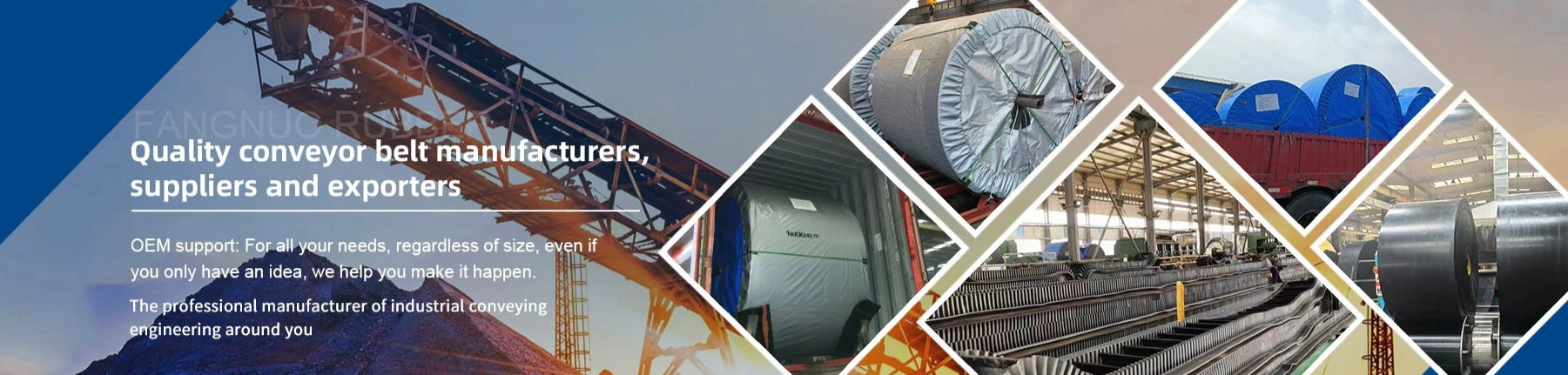
We specialize in producing heavy-duty EP nylon conveyor belts, steel cord conveyor belts, corrugated rib conveyor belts, bucket elevator conveyor belts, herringbone conveyor belts, ring conveyor belts, etc. As a Chinese conveyor belt manufacturer, supplier and exporter, we focus on providing customers with high-quality conveyor belts and better services.
Baoding Fangnuo Rubber Products Manufacturing Co., Ltd.
Copyright Baoding Fangnuo Rubber Products Manufacturing Co., Ltd., All rights reserved